Shades of a Blue Orphanage [Limited Edition]
A compilation of early material.
Thin Lizzy: Phil Lynott (vocals, bass), Eric Bell (guitar), Brian Downey (drums).
Additional personnel: Clodagh Simonds (harpsichord, Mellotron).
Personnel: Phil Lynott (vocals, acoustic guitar); Eric Bell (guitar, acoustic guitar); Clodagh Simonds (harpsichord, Mellotron); Brian Downey (drums, percussion).
Audio Remasterer: Paschal Byrne.
Liner Note Author: Mark Powell .
Recording information: De Lane Lea Music Center, Wembley, London.
Photographer: Roy Esmonde.
A fascinating, all-over-the-map album by a band that hadn't yet found its own voice (although in retrospect, hints of the band's ultimate direction can be heard here). Things get off to a roaring start with "The Rise and Dear Demise of the Funky Nomadic Tribes," which segues from Yes-derived staccato unison riffing into a funk-guitar workout influenced by Jimi Hendrix and James Brown. From there it's on to "Buffalo Gal," a melancholy folk-ish plaint that anticipates the working class Irish poetry Lizzy frontman Phil Lynott would develop to great effect later in the '70s; other stylistic detours include stabs at faux rockabilly ("I Don't Want to Forget How to Jive"), Mellotron-drenched confessional ballads (the title tune), and even a sort of visionary art-punk ("Call the Police). Pretty cool, but the best was yet to come.
Thin Lizzy: Phil Lynott (vocals, bass), Eric Bell (guitar), Brian Downey (drums).
Additional personnel: Clodagh Simonds (harpsichord, Mellotron).
Personnel: Phil Lynott (vocals, acoustic guitar); Eric Bell (guitar, acoustic guitar); Clodagh Simonds (harpsichord, Mellotron); Brian Downey (drums, percussion).
Audio Remasterer: Paschal Byrne.
Liner Note Author: Mark Powell .
Recording information: De Lane Lea Music Center, Wembley, London.
Photographer: Roy Esmonde.
A fascinating, all-over-the-map album by a band that hadn't yet found its own voice (although in retrospect, hints of the band's ultimate direction can be heard here). Things get off to a roaring start with "The Rise and Dear Demise of the Funky Nomadic Tribes," which segues from Yes-derived staccato unison riffing into a funk-guitar workout influenced by Jimi Hendrix and James Brown. From there it's on to "Buffalo Gal," a melancholy folk-ish plaint that anticipates the working class Irish poetry Lizzy frontman Phil Lynott would develop to great effect later in the '70s; other stylistic detours include stabs at faux rockabilly ("I Don't Want to Forget How to Jive"), Mellotron-drenched confessional ballads (the title tune), and even a sort of visionary art-punk ("Call the Police). Pretty cool, but the best was yet to come.
$6,900.00
Original: $23,000.00
-70%Shades of a Blue Orphanage [Limited Edition]—
$23,000.00
$6,900.00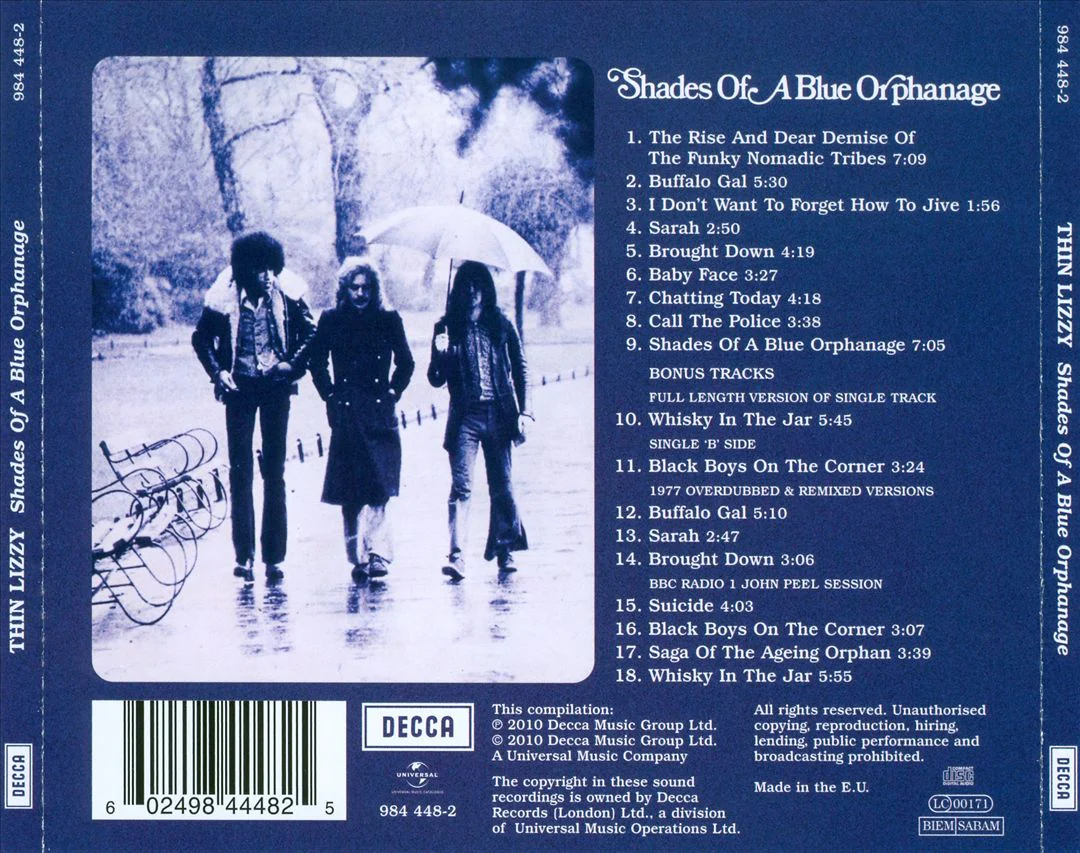
Description
A compilation of early material.
Thin Lizzy: Phil Lynott (vocals, bass), Eric Bell (guitar), Brian Downey (drums).
Additional personnel: Clodagh Simonds (harpsichord, Mellotron).
Personnel: Phil Lynott (vocals, acoustic guitar); Eric Bell (guitar, acoustic guitar); Clodagh Simonds (harpsichord, Mellotron); Brian Downey (drums, percussion).
Audio Remasterer: Paschal Byrne.
Liner Note Author: Mark Powell .
Recording information: De Lane Lea Music Center, Wembley, London.
Photographer: Roy Esmonde.
A fascinating, all-over-the-map album by a band that hadn't yet found its own voice (although in retrospect, hints of the band's ultimate direction can be heard here). Things get off to a roaring start with "The Rise and Dear Demise of the Funky Nomadic Tribes," which segues from Yes-derived staccato unison riffing into a funk-guitar workout influenced by Jimi Hendrix and James Brown. From there it's on to "Buffalo Gal," a melancholy folk-ish plaint that anticipates the working class Irish poetry Lizzy frontman Phil Lynott would develop to great effect later in the '70s; other stylistic detours include stabs at faux rockabilly ("I Don't Want to Forget How to Jive"), Mellotron-drenched confessional ballads (the title tune), and even a sort of visionary art-punk ("Call the Police). Pretty cool, but the best was yet to come.
Thin Lizzy: Phil Lynott (vocals, bass), Eric Bell (guitar), Brian Downey (drums).
Additional personnel: Clodagh Simonds (harpsichord, Mellotron).
Personnel: Phil Lynott (vocals, acoustic guitar); Eric Bell (guitar, acoustic guitar); Clodagh Simonds (harpsichord, Mellotron); Brian Downey (drums, percussion).
Audio Remasterer: Paschal Byrne.
Liner Note Author: Mark Powell .
Recording information: De Lane Lea Music Center, Wembley, London.
Photographer: Roy Esmonde.
A fascinating, all-over-the-map album by a band that hadn't yet found its own voice (although in retrospect, hints of the band's ultimate direction can be heard here). Things get off to a roaring start with "The Rise and Dear Demise of the Funky Nomadic Tribes," which segues from Yes-derived staccato unison riffing into a funk-guitar workout influenced by Jimi Hendrix and James Brown. From there it's on to "Buffalo Gal," a melancholy folk-ish plaint that anticipates the working class Irish poetry Lizzy frontman Phil Lynott would develop to great effect later in the '70s; other stylistic detours include stabs at faux rockabilly ("I Don't Want to Forget How to Jive"), Mellotron-drenched confessional ballads (the title tune), and even a sort of visionary art-punk ("Call the Police). Pretty cool, but the best was yet to come.