S7even Large
Personnel: Euge Groove (saxophone, Hammond b-3 organ, programming); Tracy Carter (piano, Fender Rhodes piano).
Audio Mixers: Euge Groove; Paul Brown .
Liner Note Author: Steven Eugene Grove.
Recording information: Brownstone Recording, Brentwood, TN; Diamond Mine Studio, Camarillo, CA; Vision Studio, Valencia, CA.
Arranger: Euge Groove.
The first couple of albums by saxophonist Euge Groove (aka Steven Eugene Grove) made Billboard's Top Contemporary Jazz Albums chart. His sixth album, Sunday Morning, was listed in the magazine's Jazz Albums chart, and that shift in category doesn't only reflect a blurring in the distinction between "contemporary" and traditional jazz. Groove hasn't become a mainstream jazz artist exactly, but he has focused more on live takes and live musicians in the studio over synthesized tracks to play over. He begins "The Funky Bunch," an original composition on his seventh album, S7even Large, with a count-in, and that emphasizes the impression that he and fellow musicians including keyboardist Tracy Carter, guitarists Ross Bolton, and John Jubu Smith, drummers Trevor Lawrence, Jr., and Dan Needham, bassist Cornelius Mims, and brass player Lee Thornburg are actually in a room together playing on the track. That may not always be the case, but the playing does have the feel of real musicians. Those musicians mostly sound relaxed and soulful, qualities Groove has aspired to before. Eventually, he gets to a cover of the `70s soul standard "Love Won't Let Me Wait," but by then he has long established his affinity for the musical style on "The Funky Bunch" and a co-write with Bolton, "Days of Soul." The title track, meanwhile, features Mims' popping electric bass patterns, another `70s R&B touchstone. Groove also allows room for Carter to solo on that track, and he includes horn charts here and there. But, of course, the dominant sound of the record is his own endlessly melodic, never-in-a-hurry saxophone playing, inventive yet familiar, in a style that by now can be considered simply jazz, without any qualifier. ~ William Ruhlmann
Audio Mixers: Euge Groove; Paul Brown .
Liner Note Author: Steven Eugene Grove.
Recording information: Brownstone Recording, Brentwood, TN; Diamond Mine Studio, Camarillo, CA; Vision Studio, Valencia, CA.
Arranger: Euge Groove.
The first couple of albums by saxophonist Euge Groove (aka Steven Eugene Grove) made Billboard's Top Contemporary Jazz Albums chart. His sixth album, Sunday Morning, was listed in the magazine's Jazz Albums chart, and that shift in category doesn't only reflect a blurring in the distinction between "contemporary" and traditional jazz. Groove hasn't become a mainstream jazz artist exactly, but he has focused more on live takes and live musicians in the studio over synthesized tracks to play over. He begins "The Funky Bunch," an original composition on his seventh album, S7even Large, with a count-in, and that emphasizes the impression that he and fellow musicians including keyboardist Tracy Carter, guitarists Ross Bolton, and John Jubu Smith, drummers Trevor Lawrence, Jr., and Dan Needham, bassist Cornelius Mims, and brass player Lee Thornburg are actually in a room together playing on the track. That may not always be the case, but the playing does have the feel of real musicians. Those musicians mostly sound relaxed and soulful, qualities Groove has aspired to before. Eventually, he gets to a cover of the `70s soul standard "Love Won't Let Me Wait," but by then he has long established his affinity for the musical style on "The Funky Bunch" and a co-write with Bolton, "Days of Soul." The title track, meanwhile, features Mims' popping electric bass patterns, another `70s R&B touchstone. Groove also allows room for Carter to solo on that track, and he includes horn charts here and there. But, of course, the dominant sound of the record is his own endlessly melodic, never-in-a-hurry saxophone playing, inventive yet familiar, in a style that by now can be considered simply jazz, without any qualifier. ~ William Ruhlmann
$6.88
Original: $22.95
-70%S7even Large—
$22.95
$6.88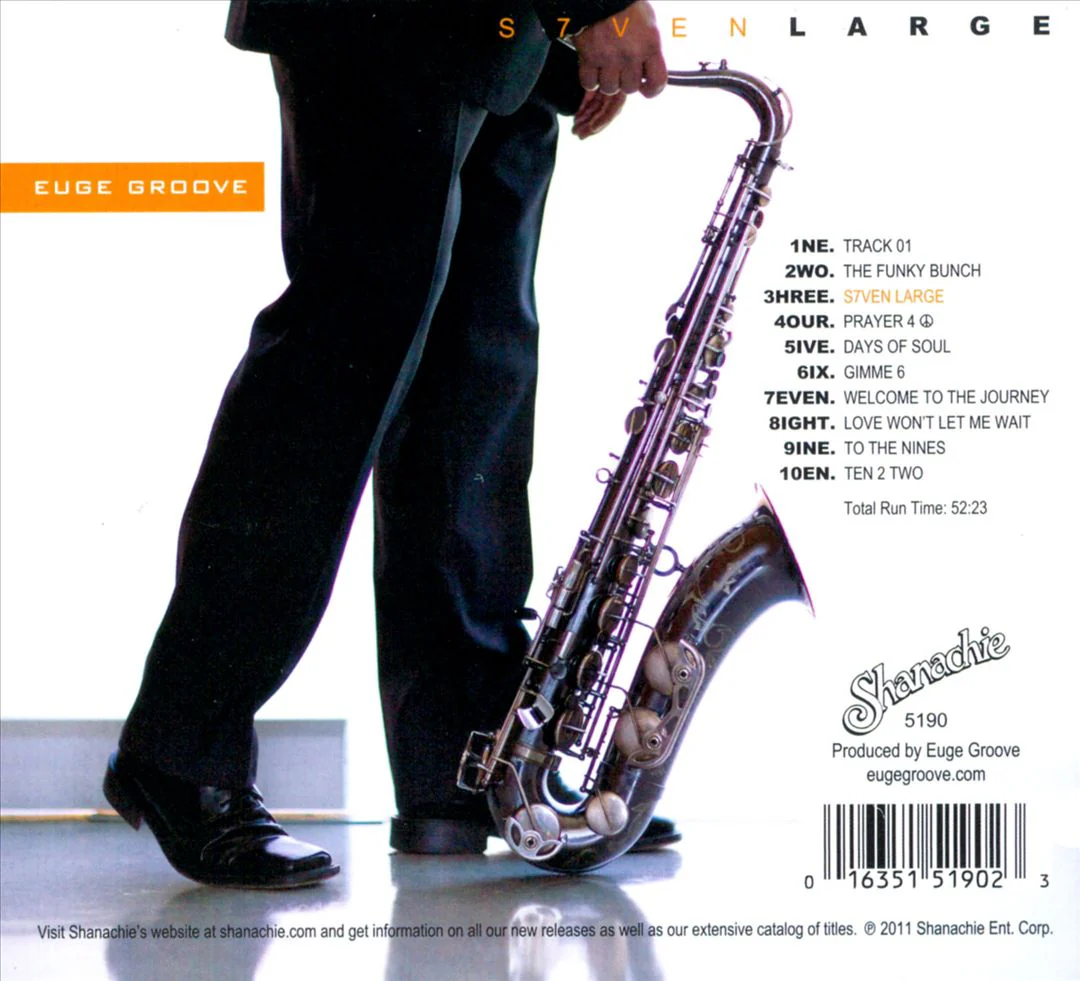
Description
Personnel: Euge Groove (saxophone, Hammond b-3 organ, programming); Tracy Carter (piano, Fender Rhodes piano).
Audio Mixers: Euge Groove; Paul Brown .
Liner Note Author: Steven Eugene Grove.
Recording information: Brownstone Recording, Brentwood, TN; Diamond Mine Studio, Camarillo, CA; Vision Studio, Valencia, CA.
Arranger: Euge Groove.
The first couple of albums by saxophonist Euge Groove (aka Steven Eugene Grove) made Billboard's Top Contemporary Jazz Albums chart. His sixth album, Sunday Morning, was listed in the magazine's Jazz Albums chart, and that shift in category doesn't only reflect a blurring in the distinction between "contemporary" and traditional jazz. Groove hasn't become a mainstream jazz artist exactly, but he has focused more on live takes and live musicians in the studio over synthesized tracks to play over. He begins "The Funky Bunch," an original composition on his seventh album, S7even Large, with a count-in, and that emphasizes the impression that he and fellow musicians including keyboardist Tracy Carter, guitarists Ross Bolton, and John Jubu Smith, drummers Trevor Lawrence, Jr., and Dan Needham, bassist Cornelius Mims, and brass player Lee Thornburg are actually in a room together playing on the track. That may not always be the case, but the playing does have the feel of real musicians. Those musicians mostly sound relaxed and soulful, qualities Groove has aspired to before. Eventually, he gets to a cover of the `70s soul standard "Love Won't Let Me Wait," but by then he has long established his affinity for the musical style on "The Funky Bunch" and a co-write with Bolton, "Days of Soul." The title track, meanwhile, features Mims' popping electric bass patterns, another `70s R&B touchstone. Groove also allows room for Carter to solo on that track, and he includes horn charts here and there. But, of course, the dominant sound of the record is his own endlessly melodic, never-in-a-hurry saxophone playing, inventive yet familiar, in a style that by now can be considered simply jazz, without any qualifier. ~ William Ruhlmann
Audio Mixers: Euge Groove; Paul Brown .
Liner Note Author: Steven Eugene Grove.
Recording information: Brownstone Recording, Brentwood, TN; Diamond Mine Studio, Camarillo, CA; Vision Studio, Valencia, CA.
Arranger: Euge Groove.
The first couple of albums by saxophonist Euge Groove (aka Steven Eugene Grove) made Billboard's Top Contemporary Jazz Albums chart. His sixth album, Sunday Morning, was listed in the magazine's Jazz Albums chart, and that shift in category doesn't only reflect a blurring in the distinction between "contemporary" and traditional jazz. Groove hasn't become a mainstream jazz artist exactly, but he has focused more on live takes and live musicians in the studio over synthesized tracks to play over. He begins "The Funky Bunch," an original composition on his seventh album, S7even Large, with a count-in, and that emphasizes the impression that he and fellow musicians including keyboardist Tracy Carter, guitarists Ross Bolton, and John Jubu Smith, drummers Trevor Lawrence, Jr., and Dan Needham, bassist Cornelius Mims, and brass player Lee Thornburg are actually in a room together playing on the track. That may not always be the case, but the playing does have the feel of real musicians. Those musicians mostly sound relaxed and soulful, qualities Groove has aspired to before. Eventually, he gets to a cover of the `70s soul standard "Love Won't Let Me Wait," but by then he has long established his affinity for the musical style on "The Funky Bunch" and a co-write with Bolton, "Days of Soul." The title track, meanwhile, features Mims' popping electric bass patterns, another `70s R&B touchstone. Groove also allows room for Carter to solo on that track, and he includes horn charts here and there. But, of course, the dominant sound of the record is his own endlessly melodic, never-in-a-hurry saxophone playing, inventive yet familiar, in a style that by now can be considered simply jazz, without any qualifier. ~ William Ruhlmann